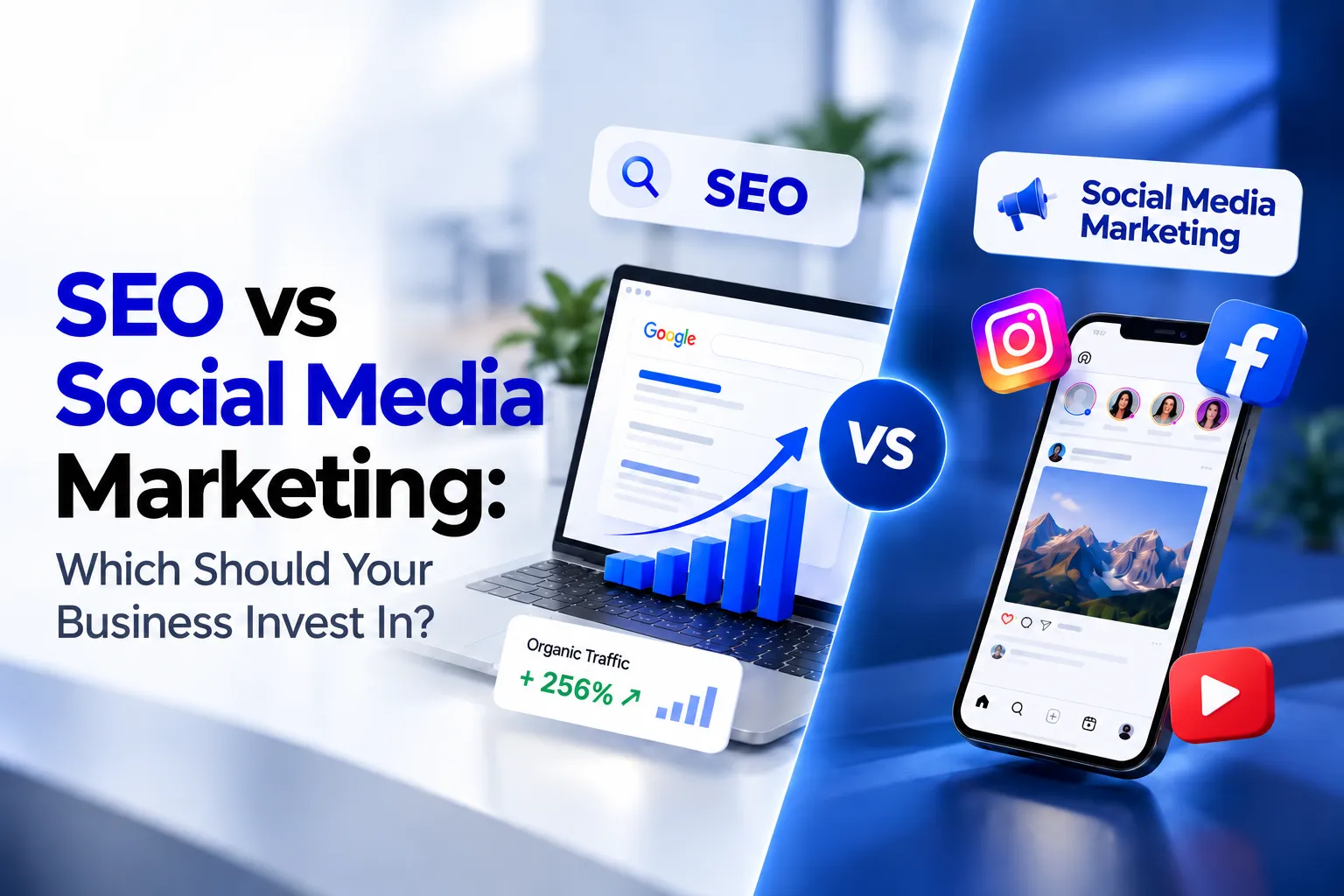
SEO and Social media marketing serve different purposes, so there is no universal winner. SEO helps businesses attract people actively searching for relevant products or services, while social media helps build awareness, engagement, and relationships. For many businesses, combining both creates a more balanced digital marketing strategy than relying entirely on one channel.
What Is the Difference Between SEO and Social Media Marketing?
The simplest way to understand SEO vs. Social Media Marketing is to look at how people discover a business through each channel.
Search Engine Optimization (SEO) focuses on improving a website’s visibility in search engine results. It helps businesses reach users who are already searching for information, products, services, or solutions.
Social media marketing focuses on reaching and engaging audiences through platforms such as Instagram, Facebook, LinkedIn, and YouTube. Instead of waiting for someone to search for a business, social media can introduce the brand to potential customers through content and advertising.
Both are important digital marketing channels, but they work differently.
| SEO | Social Media Marketing |
| Captures search demand | Builds awareness and engagement |
| Focuses on search engines | Focuses on social platforms |
| Strong focus on website visibility | Strong focus on content and community |
| Can target informational and commercial searches | Can reach audiences based on interests and demographics |
| Often takes time to build | Content can generate immediate visibility |
| Relies heavily on website and content quality | Relies heavily on creative content and audience engagement |
How Does SEO Help a Business?
SEO helps businesses become more discoverable when potential customers use search engines.
For example, someone searching for “digital marketing agency in Bangalore” already has a specific need. A business appearing for a relevant search has an opportunity to attract that person to its website.
A typical SEO marketing strategy may include:
- Keyword research
- Technical SEO
- On-page optimization
- Content creation
- Internal linking
- Local SEO
- Off-page SEO
- Website performance improvements
SEO can be particularly useful for businesses whose customers regularly search online before making a purchase or contacting a service provider.
When Should You Prioritize SEO?
SEO may deserve greater attention when:
- Customers actively search for your products or services
- Your industry has strong search demand
- You want to build long-term organic visibility
- Your website can support useful content
- You want to attract visitors without paying for every individual click
For local businesses in Bangalore, SEO can also support location-based searches such as service + Bangalore or service + neighbourhood.
How Does Social Media Marketing Help a Business?
Social media marketing works differently. Rather than primarily capturing existing search demand, it gives businesses a way to reach audiences through content, conversations, and advertising.
A social media marketing strategy can include:
- Educational posts
- Short-form videos
- Product or service showcases
- Customer-focused content
- Stories
- Community engagement
- Influencer collaborations
- Paid social media advertising
Social platforms can also give businesses a place to communicate their personality. This can be valuable for brands where visual storytelling, community interaction, or regular updates are important.
When Should You Prioritize Social Media?
Social media may deserve greater attention when:
- Your audience spends significant time on social platforms
- Your products or services are visually engaging
- Brand awareness is a major objective
- You want to build an active community
- You have the resources to create regular content
- You want to experiment with paid social advertising
For example, fashion, food, hospitality, lifestyle, beauty, entertainment, and many consumer-focused businesses can use social platforms to showcase their offerings in a highly visual way.
SEO vs Social Media: Which Gives Faster Results?
- The results depend on your business goals. SEO is generally a longer-term strategy, requiring consistent work to build organic visibility, while social media can generate reach and engagement more quickly. Paid social campaigns can also start reaching targeted audiences soon after launch.
- However, quick visibility does not always mean better business results. Measure each channel based on its objective.
- SEO metrics: Organic traffic, keyword rankings, search visibility, leads, enquiries and conversions.
- Social media metrics: Reach, engagement, video views, website visits, leads, conversions and cost per result.
Organic vs Social Media Marketing: Are They the Same?
Not exactly. Organic marketing refers to unpaid methods of attracting and engaging audiences, including SEO and organic social media. Social media marketing can include both organic content and paid advertising.
Businesses can use these channels for different purposes:
- SEO: Attract people actively searching for solutions.
- Organic social media: Build awareness and engage existing audiences.
- Social media advertising: Reach targeted audiences with specific campaigns.
Together, these channels can support different stages of the customer journey.
Should a Business Invest in SEO or Social Media First?
There is no single answer for every business.
A useful way to decide is to ask four questions.
1. How Do Your Customers Find You?
If customers commonly search for your service on Google, SEO may be an important priority.
If customers discover brands through visual content, recommendations, creators, or social feeds, social media may deserve more attention.
2. What Are Your Business Goals?
Different goals may require different channels.
| Goal | Potential Focus |
| Improve organic search visibility | SEO |
| Generate search-based website traffic | SEO |
| Build brand awareness | Social media |
| Create an engaged community | Social media |
| Capture existing search demand | SEO |
| Promote a campaign quickly | Social media advertising |
| Build long-term website visibility | SEO |
| Showcase visual brand content | Social media |
These are general guidelines rather than fixed rules.
3. What Resources Do You Have?
SEO and social media both require time, expertise, content, and consistent execution.
A business should consider whether it has the resources to:
- Create and update website content
- Produce social media creatives
- Manage campaigns
- Respond to customers
- Monitor performance
- Test and improve its strategy
Trying to do everything at once can make execution inconsistent.
4. What Does Your Existing Data Tell You?
Your current performance can provide useful clues.
Look at where website visitors come from, which pages attract traffic, which social posts generate engagement, and which channels contribute to enquiries or sales.
The goal is not simply to choose the channel with the highest traffic. It is to understand which channel brings the right audience and meaningful business actions.
Why Combining SEO and Social Media Can Make Sense?
For many businesses, SEO and social media work better together than as competing strategies.
For example, a Bangalore business can publish an SEO-focused guide on its website and repurpose the topic into:
- Instagram Reel
- LinkedIn post
- Facebook post
- YouTube video
- Educational graphic
SEO helps people discover the website, while social media can expand the content’s reach and engagement. This also makes content creation more efficient by turning one useful topic into multiple formats.
How DC Studio Can Help to Build Your Business?
DC Studio offers digital marketing services including SEO, Social Media Marketing, Performance Marketing, Website UI/UX, Content Marketing, and Branding & Design.
Its social media services cover content development, advertising, community management, influencer marketing, analytics and campaign optimization. SEO services include keyword research, on-page and technical SEO, off-page SEO, link building and SEO content writing.
The right mix depends on a business’s audience, goals, competition, budget and resources. Assessing each channel can help businesses focus their efforts where they are most relevant.
Conclusion
SEO helps businesses reach people actively searching for products or services, while social media builds awareness, engagement and audience reach. Rather than choosing one, businesses can use both based on their audience, goals, budget and marketing needs.
Not sure where your business should focus? Contact DC Studio to discuss your SEO and social media marketing requirements and build a digital strategy around your business goals.
Frequently Asked Questions (FAQs)?
1. Which is better, SEO or social media marketing?
Neither is universally better. SEO is designed to improve visibility for search-driven demand, while social media focuses more on audience reach, engagement, content distribution, and community building.
2. Is SEO part of social media marketing?
No. SEO and social media marketing are separate digital marketing disciplines, although they can support each other as part of a broader marketing strategy.
3. Is SEO more important for small businesses?
SEO can be particularly useful for small businesses whose customers actively search online for their products or services. Local SEO can also help businesses target relevant location-based searches.
4. Can social media replace SEO?
Social media generally should not be treated as a direct replacement for SEO. Each channel reaches audiences differently and supports different parts of the customer journey.
5. Should a new business invest in SEO or social media?
A new business should consider its target audience, customer behaviour, goals, resources, and search demand. In many cases, establishing a useful website presence while building social visibility can be considered together.